When a customer pays in your online store, instantly receives a WhatsApp order confirmation, and the order appears in your accounting system and your CRM without anyone typing it in, that is APIs working in the background. This guide explains what an API is in plain terms, the integrations businesses need most, and how to implement them securely.
The short answer: an API (application programming interface) is an agreed way for two systems to talk to each other. Through API integration, your website can connect to payment gateways, WhatsApp, your CRM, accounting and shipping, so data moves automatically instead of being copied by hand. Done securely, it saves time, cuts errors and lets you respond to customers instantly around the clock.
What Is an API?
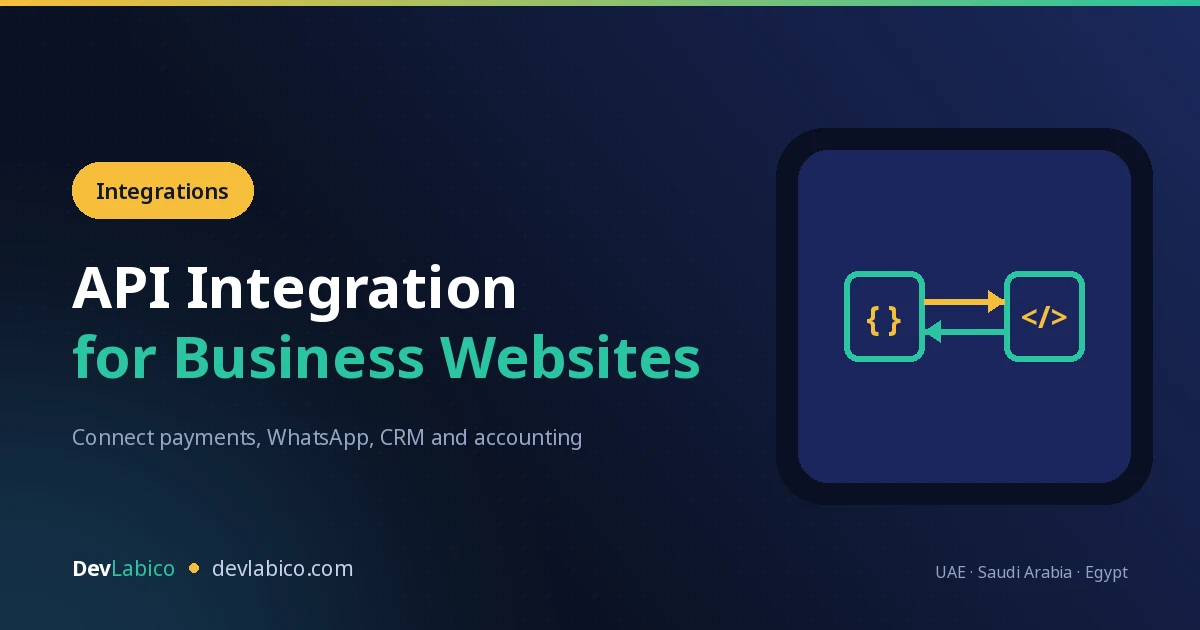
An API is an agreed way for two systems to communicate. Think of it as the order window in a restaurant: your system sends a request in a set format, and the other system replies with the result, without either one needing to know how the other works inside.
There are also webhooks, which work the other way round: the other system automatically notifies yours when something happens, such as a successful payment or a new incoming message.
The Most Important API Integrations for Business Websites
| Integration | What it does for you |
|---|---|
| Payment gateways | Online payments with automatic order confirmation, such as mada and Apple Pay in the Gulf, or Paymob and Fawry in Egypt |
| WhatsApp Business | Automatic confirmations, reminders and follow-ups, plus customer requests flowing into your system |
| CRM | Every contact form becomes a lead with its source, with no manual copying |
| Accounting and invoicing | Invoices issued automatically with every order, in line with e-invoicing requirements in your country |
| Shipping companies | Creating shipments, tracking them and updating the customer on their status |
| Maps and location | Showing branches and calculating distances and delivery fees |
| SMS and email | Verification codes, notifications and campaigns |
For WhatsApp specifically, see our guide to the WhatsApp Business API.
Benefits of Connecting Your Systems via API
- Time saved: no more manual data entry between systems.
- Fewer errors: data moves exactly as it is, with no copying mistakes.
- Faster customer response: instant messages and confirmations around the clock.
- One view of the customer: data from the website, sales and support in one place.
Is your team copying data between systems by hand? We connect websites to payment gateways, WhatsApp, CRM and accounting systems so data flows automatically and securely. Message us on WhatsApp.
How to Implement Integrations Securely
- Keep API keys on the server only, and never put them in code that reaches the browser.
- Give each key the minimum permissions it needs.
- Verify the signature of every webhook before acting on it, so nobody can send you a fake payment notification.
- Log all requests and errors so any problem can be traced.
- Handle failures in the other system with automatic retries instead of losing data.
- Protect customers' personal data in line with the data protection laws in your country.
How to Get Started
- List every task your team repeats by hand between two systems.
- Rank them by the time they consume and the errors they cause.
- Check that the systems involved offer a documented API.
- Start with the integration that has the biggest impact, then add the rest gradually.
Integrations are a core part of any custom system. If your team is outgrowing off-the-shelf tools, read our guide to custom CRM development.
Frequently Asked Questions
Can a WordPress website be connected to other systems via API?
Yes. WordPress has its own API, and it can be connected to payment, CRM and accounting systems through plugins or custom code.
What determines the effort involved in an API integration?
The complexity of the integration and how well the other system is documented. Some services also charge usage fees, such as certain types of WhatsApp Business messages.
What happens if the other system goes down?
In a well-designed integration, requests are stored and automatically retried once the system is back, with no data lost.
Connect Your Systems with DevLabico
At DevLabico we build API integrations between websites, payment gateways, WhatsApp, CRM and accounting systems for businesses in Saudi Arabia, the UAE and Egypt. Message us on WhatsApp or tell us which systems you use and we will propose an integration plan.